
Programme for the day
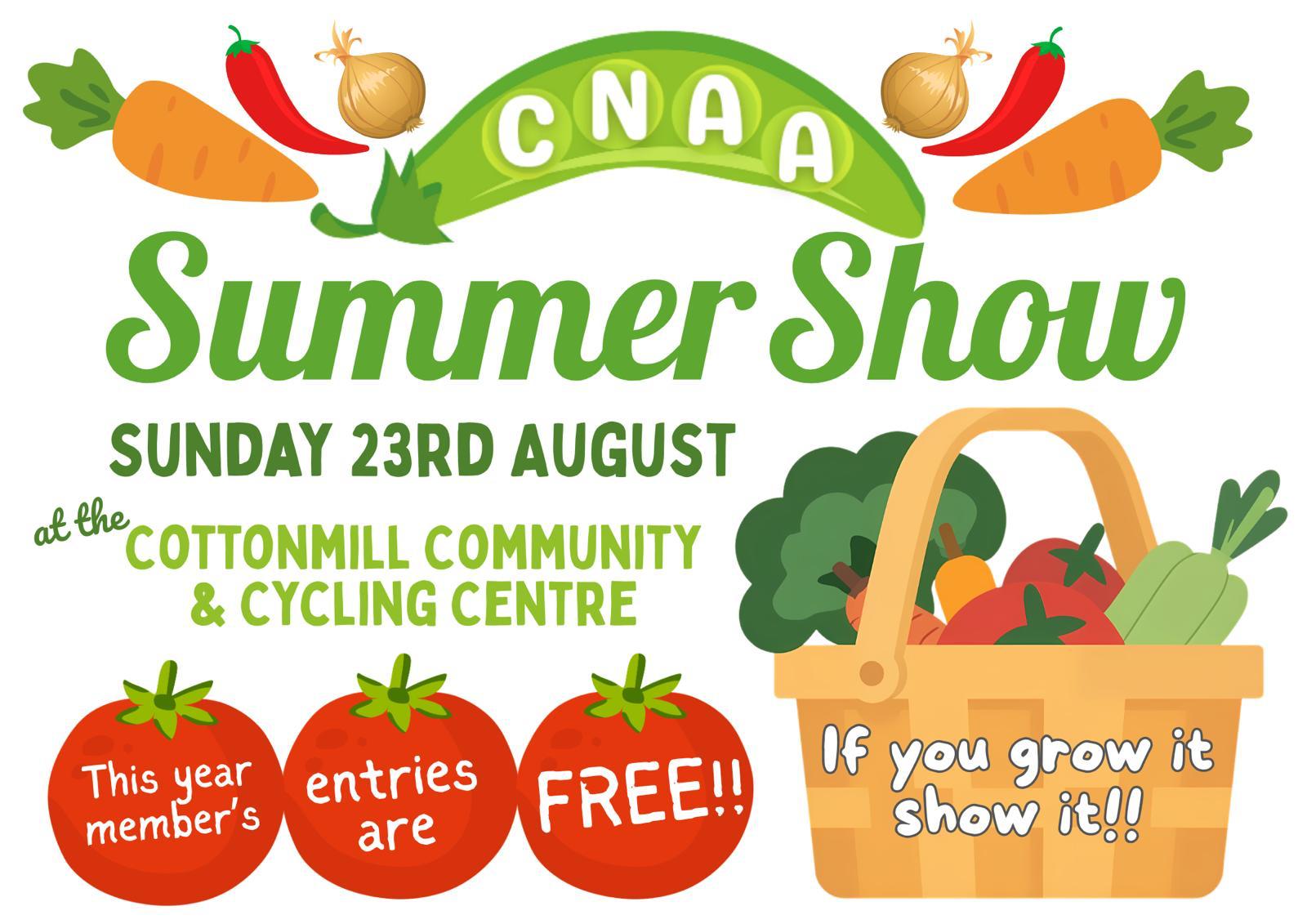
The CNAA Summer Show will take place on Sunday 23 August 2026 at the Cottonmill Community and Cycling Centre (12 Old Oak, St Albans AL1 2EF).
CNAA members are invited to bring and register their entries between 10:15 am and 11:00 am.
Judging will take place between 11:15 am and 13:00 pm. The showroom will be closed during this time, but members are welcome to stay and chat in the café area, return home, or visit their allotments.
The room will reopen at 13:00 pm, when everyone is welcome to view the entries and see the winning exhibits. The prize-giving ceremony will take place at around 13:30pm, and the event is expected to finish at approximately 2:00 pm.
Entries and Prizes
Entry is FREE for CNAA members this year, making this an excellent opportunity to display your best produce.
Prizes will be awarded in individual categories, so you do not need to compete for the overall title to win something. Your onions, for example, could still win the prize for the best entry in their category.
The competition rules have also changed this year to give members with smaller plots a fairer chance of winning the Ryder Cup. You may submit as many entries as you wish, but only your ten highest-scoring entries will count towards your final overall score.
There will also be a raffle, with two tickets to the Abbey Theatre as the first prize.
Prizes will be available for both children and adults.
If you are not yet a CNAA member and would like to join, please visit our how to join page for further information.
Instructions for the day
1. Choose your categories
First, decide which categories you would like to enter. Then print and fill the following form:
2. Complete an entry card
Complete a separate entry card for each exhibit.
You can download and print the entry cards below:
3. Prepare your exhibits
Prepare your produce in accordance with the rules in the RHS Horticultural Show Handbook. Following the guidance carefully will reduce the risk of an entry being disqualified because of an avoidable presentation or preparation issue.
You can also ask an experienced plot holder, a committee member, or an AI assistant for advice about preparing a particular type of produce.
Below are a few general examples.
🍐 Pears
- Condition: Fresh, free from blemishes or russeting (unless typical of the cultivar).
- Uniformity: All fruits should match in size, shape, and ripeness.
- Size: Good size for cultivar, but not coarse.
- Stalks: Intact, not shrivelled or broken.
- Bloom: Natural bloom should be preserved (avoid over-polishing).
- Arrangement: Usually staged on a plate in a neat and balanced way.
🍅 Tomatoes
- Condition: Fresh, clear skin, no blemishes, cracks, or greenback.
- Uniformity: All fruits the same size and colour.
- Size: Depends on class (standard, cherry, beefsteak). Standard usually golf-ball sized.
- Stalks: With calyces, fresh and intact.
- Colour: Clear, ripe but firm, typical of cultivar.
- Trusses (if shown): Should be complete, with evenly ripened fruit.
🥔 Potatoes
- Condition: Clean, shallow eyes, no greening or skin blemishes.
- Uniformity: All tubers matching size and shape.
- Size: Medium (150–200g each) is preferred, not oversized.
- Shape: True to cultivar, regular, and not distorted.
- Skin finish: Clear and bright for white potatoes; unbroken and evenly coloured for coloured types.
🥕 Carrots
- Size: Good size for cultivar, not coarse.
- Condition: Clean, free from pest damage or greening at the crown.
- Uniformity: All roots matched in length, shape, and colour.
- Shape: Long, straight, and parallel-sided with a pointed tip.
- Skin: Smooth and free from cracks or forking.
- Foliage: Trim neatly to approximately 7.5 cm (3 inches).
Tips from our judge
Here are some useful tips from our judge, J-P:
- Read the instructions carefully, and then read them again. If a category asks for four tomatoes, make sure you enter exactly four, not three or five.
- Preparation is essential. Look at what you have growing now and consider what is likely to be ready at the time of the show. Think about which produce can be lifted and prepared in advance, such as onions, and which should be cut on the day or the day before, such as cabbages.
- When vegetables are entered as a group, closely matched specimens are ideal. However, do not be discouraged if they are not perfect. You may not win first prize, but your entry could still place second or third.
- Do not be afraid to ask other plot holders for advice, particularly if you are new to exhibiting. Experienced growers will usually be happy to help.
- For sweetcorn, carefully peel back the husk approximately one-third of the way down on one side. The judge may press a kernel to check for a milky liquid, which indicates ripeness.
- Onions can be lifted in advance and allowed to dry. Do not remove too many outer skins, and leave the roots attached.
- Finally, check the schedule and entry requirements again before submitting your exhibits. Entries containing produce of the wrong size, number or type may be disqualified.
General Competition Rules
- Each entry will be judged individually and awarded first place, second place, third place or no placing. Entries placed first, second or third will receive the appropriate sticker.
- Points will be awarded as follows:
- First place: 3 points
- Second place: 2 points
- Third place: 1 point
- Only each entrant’s ten highest-scoring entries will count towards their overall score. The maximum possible score is 30 points.
- The entrant with the highest overall score will be named Best in Show. The entrants with the next two highest scores will be awarded second and third place overall.
- If two or more entrants have the same overall score, the tie will be broken by comparing their next highest-scoring placed entries. Additional placed entries will be considered one at a time until the tie is broken.
Best in Class Rules
Newcomer and Children’s Classes
- Entries in classes 27–29 will be judged separately.
- One winning entry will be selected from each class, and the entrant will receive a prize.
CNAA’s Choice Rules
- Up to three CNAA’s Choice prizes may be awarded. These prizes will be based on the overall quality of the entries and the aim of distributing prizes fairly.*
- Entries in classes 1–26 are eligible for a CNAA’s Choice award.
- Each selected entrant will be named a CNAA’s Choice winner and awarded a prize.
*Entrants who have already received prizes in the other competitions are less likely to receive a CNAA’s Choice award.
If you are unsure about anything, please contact the committee and we will be happy to help.
Good luck to everyone taking part!
